Operations and measurement · DP091
A useful privacy issue register shows owners and next actions
Use a privacy issue register to connect evidence, affected workflows and accountable next actions instead of merely storing concerns.
Research cutoff: . This dated explainer is general information; check the linked instruments and your circumstances before acting.

‘Customer data may be in old folders’ is a concern. ‘The completed-orders export remains accessible to three former project accounts; the operations manager will remove access and verify the result by Friday’ is an actionable issue.
A privacy issue register should help the team move from the first kind of statement to the second. Its value lies in the decision it supports, not in the number of concerns it stores.
Record what is known
Start with the observation, the affected workflow and the evidence. Distinguish a confirmed fact from a suspicion or a question. If a shared link appears too broad, record what the permitted check showed and what remains unknown. Do not label an event a confirmed breach merely because a control looks weak, and do not dismiss it merely because harm has not been established.
Give potentially urgent events an escalation route outside the ordinary backlog. Incident assessment and any applicable reporting process should not wait for the next routine issue meeting. The register can link to that process without exposing unnecessary personal detail to everyone who reads the list.
As of 22 October 2026, the relevant substantive DPDP duties are scheduled for 13 May 2027 under the commencement notification. The future section 8 accountability, measures and safeguards framework, developed in part by rule 6, makes a usable issue process valuable. The register described here is a recommended working method, not a prescribed statutory template.
Give each issue a decision-shaped description
Include the process, data category, affected access or use, current control and the reason the issue matters. Keep the description specific enough that the owner can investigate it without guessing what the author meant.
Add an accountable owner and a concrete next action. ‘IT to review’ is usually too broad. ‘System administrator to test whether the old export account can still read the folder and report the result’ defines a task that can be completed or escalated.
A target date should reflect the situation and dependencies. Record the reason for a delay and the interim control where relevant. Repeatedly moving the date without explaining the remaining risk hides the problem rather than managing it.
A hypothetical access issue
A small services business finds that a former contractor’s account appears in the permissions list for a customer-project folder. The issue records the folder, the account, the date observed and the uncertainty about recent use. The team follows its incident-triage process to assess whether further action is needed.
The access owner removes the unnecessary permission and checks related groups and shared links. An authorised test confirms that the former access route no longer works. The reviewer then asks whether the same account has other assignments that need checking.
The issue is closed only for the verified scope. A separate action remains open for the wider account review if that work is not complete. The closure note does not claim that no information was ever accessed unless evidence supports that statement.
Separate different kinds of unresolved work
A missing technical control, an unclear legal interpretation and an unanswered vendor question need different owners and evidence. Avoid combining them into one vague high-risk item that nobody can resolve.
For a legal question, record the precise activity, sources considered and decision needed. For a vendor question, record the promised response, scope and consequence if the answer remains unavailable. For a technical fix, define the behaviour that will demonstrate success.
Use categories to make routing easier, but do not let category labels replace the explanation. A colour or score can support prioritisation only if the underlying criteria are visible.
Protect the register itself
Issue records can contain sensitive details about systems and people. Keep raw personal data out where an identifier, category or restricted evidence link will suffice. Limit access to detailed incident material and credentials; a ticket should never become a convenient store of live secrets.
Retain the evidence needed to understand the decision under the applicable recordkeeping approach. Avoid copying the entire affected dataset merely to show that a problem existed.
Review for movement, not just age
In a regular review, ask which issue needs a decision, which dependency is blocked and which claimed fix still lacks evidence. Close duplicates carefully while preserving the relevant scope. Reopen a closed issue if the tested behaviour regresses.
A concern stays unresolved when the register records it without assigning change. A useful entry names what is known, what happens next and how the team will recognise a sufficient result. That makes the list an operational tool rather than an archive of unresolved anxiety.
Move an issue from observation to verified closure
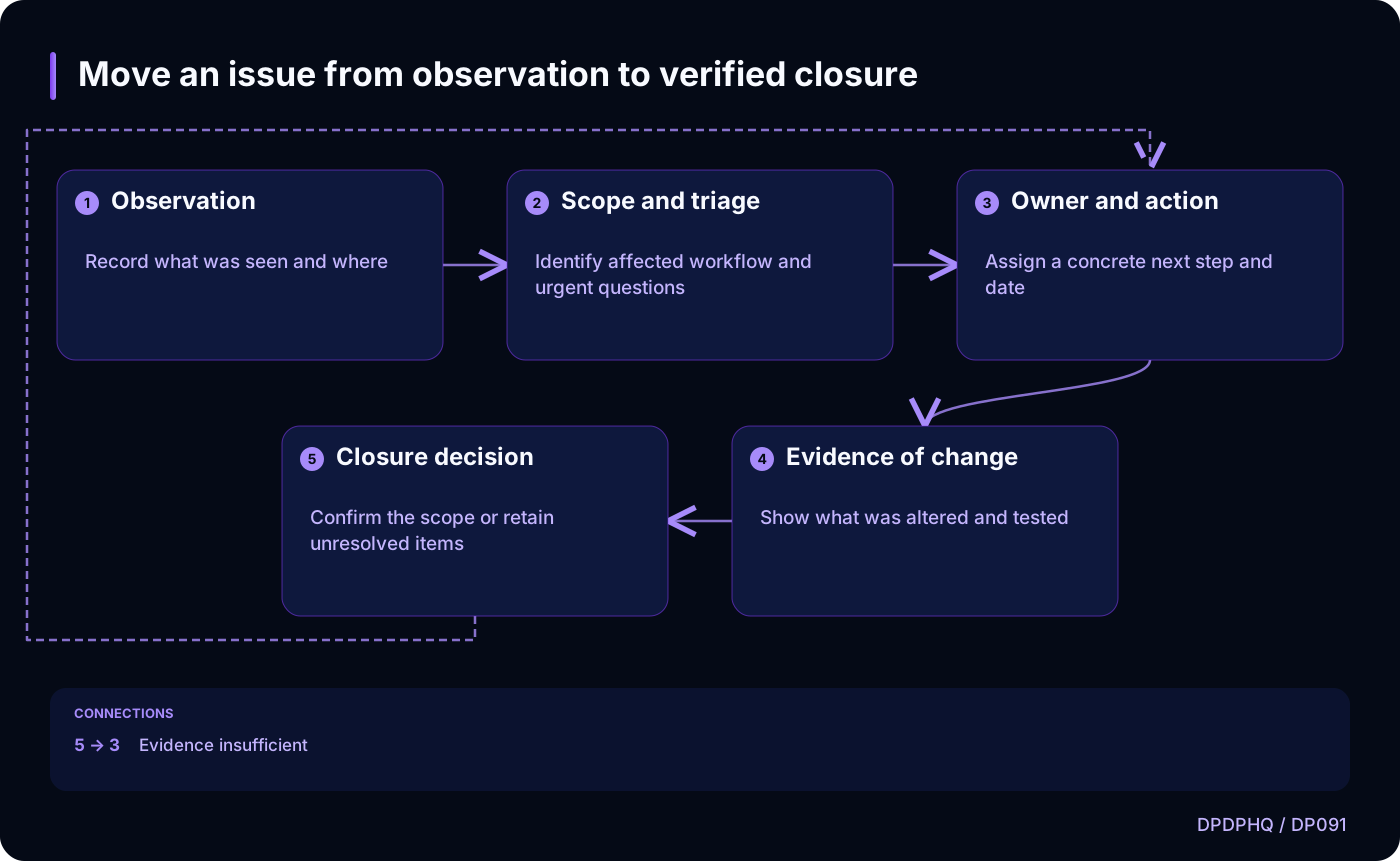
Text version of the diagram
- Observation: Record what was seen and where
- Scope and triage: Identify affected workflow and urgent questions
- Owner and action: Assign a concrete next step and date
- Evidence of change: Show what was altered and tested
- Closure decision: Confirm the scope or retain unresolved items
- Observation → Scope and triage
- Scope and triage → Owner and action
- Owner and action → Evidence of change
- Evidence of change → Closure decision
- Closure decision → Owner and action: Evidence insufficient
Sources and reading context
These references support the original 22 October 2026 research. Source links and the date above make the scope of this article explicit.
- Commencement notification for provisions of the DPDP Act · paragraph (c)
Dates future duties
- Digital Personal Data Protection Act, 2023 · sections 8(1), 8(4), 8(5)
Accountability, organisational measures and safeguards
- Digital Personal Data Protection Rules, 2025 · rule 6
Access and related controls