Rights and grievances · DP019
Erasure requests when invoices and disputes still need records
Handle an erasure request by separating active customer use from records needed for invoices, legal obligations or disputes, with a specific explanation of what remains.
Research cutoff: . This dated explainer is general information; check the linked instruments and your circumstances before acting.

An account can close while an invoice remains relevant. A customer can withdraw marketing consent while a dispute about a completed order continues. These are not contradictions if the business can explain the separate purpose and legal basis for retaining each category of information.
Under section 12(3) of the DPDP Act, requested erasure is subject to retention necessary for the specified purpose or legal compliance. Section 12 applies within its prior-consent scope, including section 7(a). Section 8(7) also contains a legal-retention exception. As of 22 October 2026, these substantive provisions are scheduled for May 2027, alongside the final Rules’ retention provisions, under the commencement notification.
Break the request into record categories
Do not begin with “delete everything” or “we must keep everything”. List the relevant categories: account profile, promotional preferences, order details, invoices, support conversations, delivery evidence and any dispute file. Identify the purpose, system and applicable retention reason for each.
The account profile may be unnecessary for a closed service while a transaction record remains needed under another law. A lengthy support conversation may contain details unrelated to the dispute. A category-level assessment makes it possible to remove unnecessary material without destroying required evidence.
Avoid guessing a universal tax or accounting retention period. The applicable period depends on the records, entity and legal requirements. Ask the responsible finance or legal owner to identify the authority and trigger, then record it in the decision.
A hypothetical damaged-goods dispute
Imagine a furniture seller receives an erasure request from a customer disputing damage to a delivered table. The seller holds contact details, an invoice, delivery photographs, complaint messages and a promotional audience entry.
The dispute does not automatically justify leaving the customer in marketing campaigns. Nor does it necessarily justify keeping every unrelated conversation. Identify which records are needed to address the claim, which require retention under another rule and which can leave ordinary use or be erased when appropriate.
Section 17(1)(a) provides a specified exemption for processing necessary to enforce a legal right or claim, with section 8(1) accountability and section 8(5) security retained. It should be applied to the relevant processing, not treated as an unlimited archive permission whenever a customer is unhappy.
Reconcile the final retention rule
Under the later framework, rule 8(3) will require Data Fiduciaries to retain personal data, associated traffic data and processing logs for at least one year from processing for the specified Seventh Schedule purposes, followed by erasure unless further retention is required under the stated conditions.
That provision is easy to miss in draft-era summaries. It means an erasure design should be reviewed against the final Rules rather than promise immediate destruction of every record on demand. The precise implementation may require careful legal and technical analysis, especially where several retention requirements overlap.
Storage for a retained purpose should be distinguished from ordinary reuse. Restrict access, prevent the retained record from feeding optional campaigns and define what will trigger a later deletion review. A record that remains stored should not quietly retain every previous business use.
Explain a partial outcome clearly
A useful response identifies what has been erased or stopped, what remains, the reason for each retained category and the relevant period or review trigger where available. It also gives a route to question the decision.
Avoid a dense citation with no explanation. “We retain the invoice because…” helps the customer understand more than “subject to applicable law”. Equally, do not disclose privileged advice or information that would compromise another person’s rights merely to make the response exhaustive.
Keep the decision and evidence of completion. If a processor must act, send a bounded instruction and verify its result. A customer-facing reply should not say every vendor copy is gone when the business has only changed the central account status.
Make the exception expire
Assign an owner and review date to dispute-related retention. When the claim ends, assess whether any other requirement still applies and release the hold when appropriate. Without that review, a temporary reason can become permanent by neglect.
Check backup treatment separately. A backup may have its own controlled lifecycle and restoration safeguards; it should not be confused with an active customer profile. Explain any material limitations accurately instead of promising a deletion mechanism the system cannot perform.
The operational goal is a justified partial decision when complete immediate erasure is inappropriate. The business should be able to show that it stopped unnecessary use, retained only what the applicable reasons support and set a real path for the remaining records to be reviewed and removed.
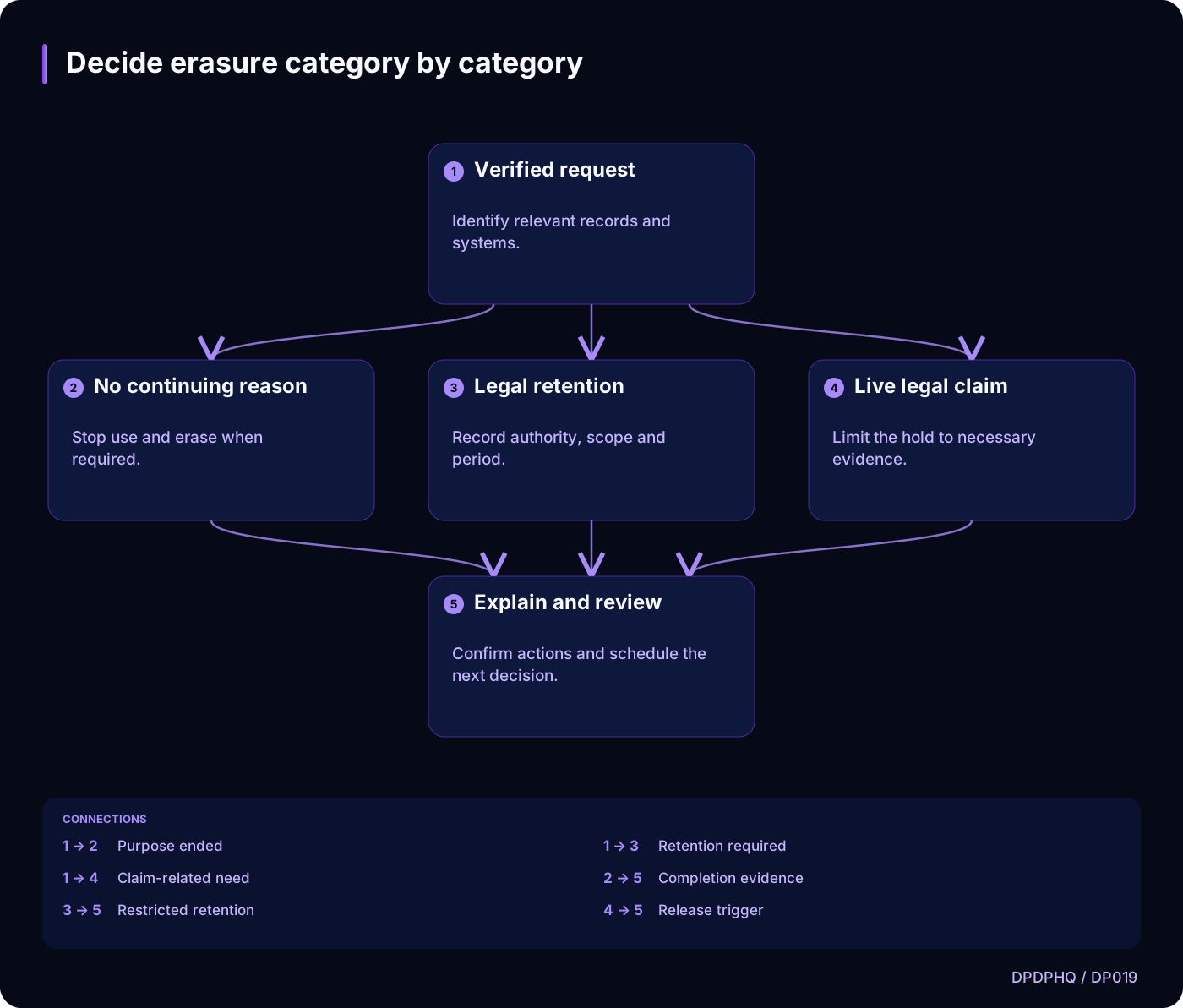
Decide erasure category by category
Text version of the diagram
- Verified request: Identify relevant records and systems.
- No continuing reason: Stop use and erase when required.
- Legal retention: Record authority, scope and period.
- Live legal claim: Limit the hold to necessary evidence.
- Explain and review: Confirm actions and schedule the next decision.
- Verified request → No continuing reason: Purpose ended
- Verified request → Legal retention: Retention required
- Verified request → Live legal claim: Claim-related need
- No continuing reason → Explain and review: Completion evidence
- Legal retention → Explain and review: Restricted retention
- Live legal claim → Explain and review: Release trigger
Sources and reading context
These references support the original 22 October 2026 research. Source links and the date above make the scope of this article explicit.
- Digital Personal Data Protection Act, 2023 · Sections 8(7), 12(3) and 17(1)(a)
Erasure exceptions and legal claims
- Digital Personal Data Protection Rules, 2025 · Rule 8(3) and Seventh Schedule
Final mandatory-retention provision
- Commencement notification for provisions of the DPDP Act · Paragraph (c)
Future substantive commencement