Vendors and transfers · DP053
Tracking subprocessors without drowning in vendor paperwork
A practical way to track meaningful downstream processing without collecting a mountain of vendor paperwork.
Research cutoff: . This dated explainer is general information; check the linked instruments and your circumstances before acting.

Imagine receiving a vendor spreadsheet containing eighty companies with a request to acknowledge an updated subprocessor list. Your business uses one small part of its service. Reading every row with equal intensity is unlikely to reveal the change that matters: whether a new company will receive your customers’ information, and what that company can do with it.
Subprocessor tracking works best as a map of actual processing. The map can be short. It needs to connect your business purpose, the provider’s task, the downstream recipient and the data that crosses each boundary.
Start with the accountable relationship
As of 22 October 2026, the relevant substantive DPDP duties are scheduled for 13 May 2027 under the commencement notification. The steps here are a readiness method. When those duties commence, outsourcing will not remove the Data Fiduciary’s accountability, and the specified engagement of a processor will require a valid contract under section 8(1) and 8(2). The final Rules also provide for processor-contract security safeguards in rule 6(1)(f).
The Act distinguishes a party deciding purposes and means from a processor acting on its behalf. A supplier’s preferred label does not settle that distinction. A downstream company may perform an instructed task, or make an independent decision about another use. Ask about the activity before accepting the label.
Keep a register that answers a real question
For each material downstream service, record its name, the function it performs, the categories of personal data it can receive, the relevant location information, and the main provider responsible for instructions. Add an evidence link, the date checked and the next review trigger. Avoid collecting individual vendor employees’ identity documents merely to make the register look thorough.
You do not need a separate row for a vendor that never touches your data just because it supplies office furniture to your provider. Conversely, an unnamed support organisation with access to live customer records may matter more than a prominently disclosed hosting company. The useful boundary is actual access or processing, including temporary troubleshooting access.
A good first question is: which of the companies on this list could receive data through the features we have enabled? A second question follows: can the provider show what fields leave its system? An architecture description tied to your selected configuration is more informative than a generic list alone.
A hypothetical booking chain
Consider a salon using a booking platform. The salon records a name, appointment time and phone number. The platform uses another provider to deliver reminders. That second provider needs the destination and message content; it may have no reason to receive the customer’s service history or staff notes.
The salon’s register can show that limited handoff. If the platform later adds an analytics supplier, the important review is whether identifiable appointment information will be sent to it. A change that affects only anonymised service statistics may require a different assessment from a change that gives a support contractor full access. Do not assume the statistics are anonymous without checking how they are produced.
In this example, the owner can ask for a narrower message payload and a confirmation of who can see delivery logs. Those two answers improve the decision more than collecting unrelated policy documents from every company in the chain.
Agree which changes deserve attention
As a contractual practice, ask for a usable change-notification route. Define material events such as a new recipient of personal data, a new processing purpose, a change in support access, or a changed transfer arrangement. Name someone in your business to assess those notices. A mailbox nobody reads is not a control.
The DPDP sources cited here do not prescribe a universal subprocessor spreadsheet or a blanket customer-approval procedure for every downstream supplier. Requirements in your contract or another applicable regime may go further. Record what you have agreed instead of presenting a preferred procurement process as a statutory rule.
Close the loop with a decision
For each material change, write down the question, the evidence, the decision and any condition. You might accept the change, disable an unnecessary feature, narrow the data sent, seek a contractual amendment or choose another service. If a reply is missing, record an unresolved issue with an owner rather than marking the vendor approved.
The common failure is treating a complete list as proof of control. Completeness matters, but a list cannot show that instructions are followed or access is limited. Sample one real handoff, reconcile it with the register, and update the map when the workflow changes. That keeps the paperwork attached to the customer data it is meant to protect.
Follow the actual downstream data path
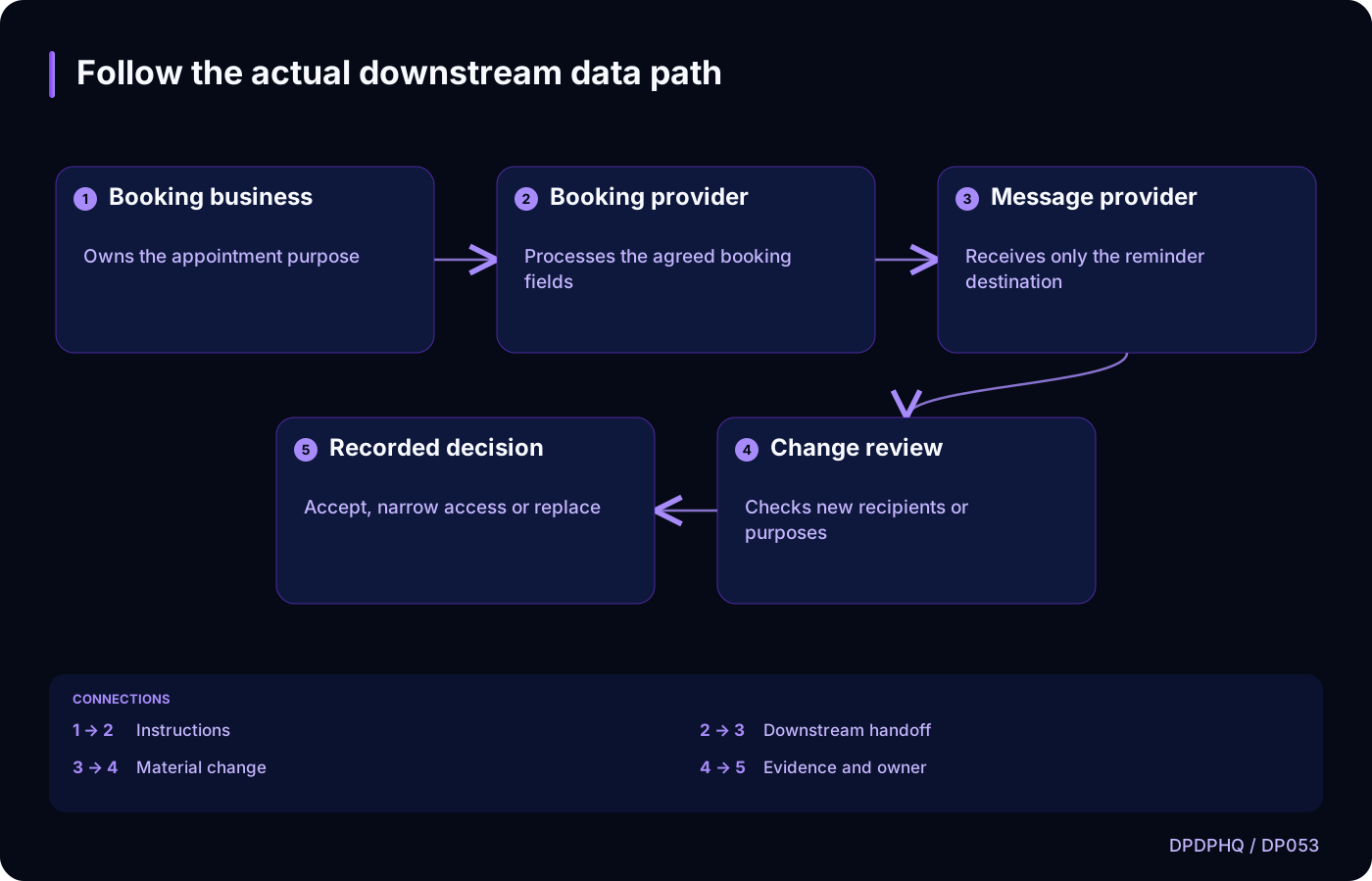
Text version of the diagram
- Booking business: Owns the appointment purpose
- Booking provider: Processes the agreed booking fields
- Message provider: Receives only the reminder destination
- Change review: Checks new recipients or purposes
- Recorded decision: Accept, narrow access or replace
- Booking business → Booking provider: Instructions
- Booking provider → Message provider: Downstream handoff
- Message provider → Change review: Material change
- Change review → Recorded decision: Evidence and owner
Sources and reading context
These references support the original 22 October 2026 research. Source links and the date above make the scope of this article explicit.
- Commencement notification for provisions of the DPDP Act · paragraph (c)
Dates the substantive obligations
- Digital Personal Data Protection Act, 2023 · sections 2(i), 2(k), 8(1), 8(2)
Explains roles and retained accountability
- Digital Personal Data Protection Rules, 2025 · rule 6(1)(f)
Supports contractual security safeguards