Retention and deletion · DP048
When a legal hold interrupts an ordinary deletion schedule
Use a scoped legal hold to preserve relevant records without suspending every deletion process, with an owner, reason, restrictions and a release decision.
Research cutoff: . This dated explainer is general information; check the linked instruments and your circumstances before acting.

A dispute can change the treatment of particular records. The business may need to preserve an order history, correspondence or relevant system evidence even though an ordinary schedule would otherwise remove it. The difficult part is defining what must remain without turning one dispute into an indefinite freeze on every customer’s data.
A legal hold is an operational instruction used to preserve identified material for a legal need. The appropriate basis and scope depend on the facts and applicable law. The label itself is not a universal exemption or a reason to keep everything that might someday be interesting.
As of 22 October 2026, the main DPDP provisions discussed here are scheduled for 13 May 2027 under the commencement notification. Current preservation, litigation and sector requirements should be assessed with suitable legal input.
Identify the actual reason for preservation
Start with the claim, proceeding, statutory obligation or other concrete legal requirement. Record who authorised the hold and what information is relevant. Avoid a generic instruction such as “retain all customer data because legal may need it”.
The future section 8(7) recognises retention necessary for compliance with law within its erasure framework. Section 17(1)(a) provides a scoped exemption where processing is necessary for enforcing a legal right or claim, while the listed provision preserves the obligations in sections 8(1) and 8(5).
Those provisions require attention to necessity and scope. They do not remove accountability or security simply because a dispute exists. Nor should a business assume that all commercial disagreements justify the same preservation measures.
Define the material with enough precision
A hypothetical furniture company faces a dispute about a damaged delivery. Relevant records may include the order, delivery photographs, customer correspondence and information identifying the particular delivery team. The dispute does not automatically require preserving every promotional profile or unrelated customer enquiry.
Describe the date range, people, transaction references, systems and record categories. Identify whether metadata or logs are needed to understand the evidence. A vague instruction can lead one team to save too little and another to retain an entire database.
Include relevant suppliers. If a delivery platform holds the photographs, the business needs to know how to communicate and verify preservation. An internal note cannot prevent a supplier’s ordinary deletion process unless the instruction reaches the appropriate party and is supported by the arrangement.
Change handling, not just the deletion date
A hold should identify which ordinary disposal jobs must be suspended for the relevant material. It should also state who can access the preserved records and what uses remain permitted. Preservation for a claim does not automatically authorise unrelated marketing or employee browsing.
Preserve the integrity of the material and protect it appropriately. Where a record is disputed, retain the original and document the challenge or correction separately where appropriate. The future Rule 6 safeguards remain relevant to the business’s security design, while the final retention rules have their own provisions. A legal exception should be integrated into the schedule rather than maintained as an undocumented folder outside all controls.
Where a working copy is necessary, record why it exists, who controls it and how it relates to the source. Avoid proliferating evidence copies without a plan for access and eventual disposal.
Respond to requests with a category-based explanation
If an affected person requests erasure, examine the request and the hold together. Some information may be erasable while relevant material remains justified. Section 12 provides erasure rights for processing based on prior consent, including section 7(a), and recognises retention necessary for the specified purpose or compliance with law.
The response should explain the decision clearly without revealing privileged advice or another person’s information. Do not promise complete erasure when records remain under a valid requirement. Equally, do not reject every part of the request merely because one category is held.
Keep the reasoning and authorisation in the internal record. If the facts are disputed or the legal position is uncertain, obtain an appropriate decision rather than asking an operator to improvise.
Review and release the hold
Assign an owner and a review trigger, such as a material change in the proceeding or a scheduled legal review. Completion of one stage does not always mean the entire need has ended, so release should be authorised using the relevant facts.
When the hold ends, return the records to the ordinary retention analysis. Check whether their normal period has already expired and apply the resulting action across the relevant copies and suppliers. Do not simply remove the hold label and leave the material untouched forever.
A defensible hold can explain three things: why these records were preserved, how their use was controlled and who decided when preservation could end. That explanation is more useful than a sweeping instruction that suspends deletion without boundaries.
A legal hold should have scope and an exit
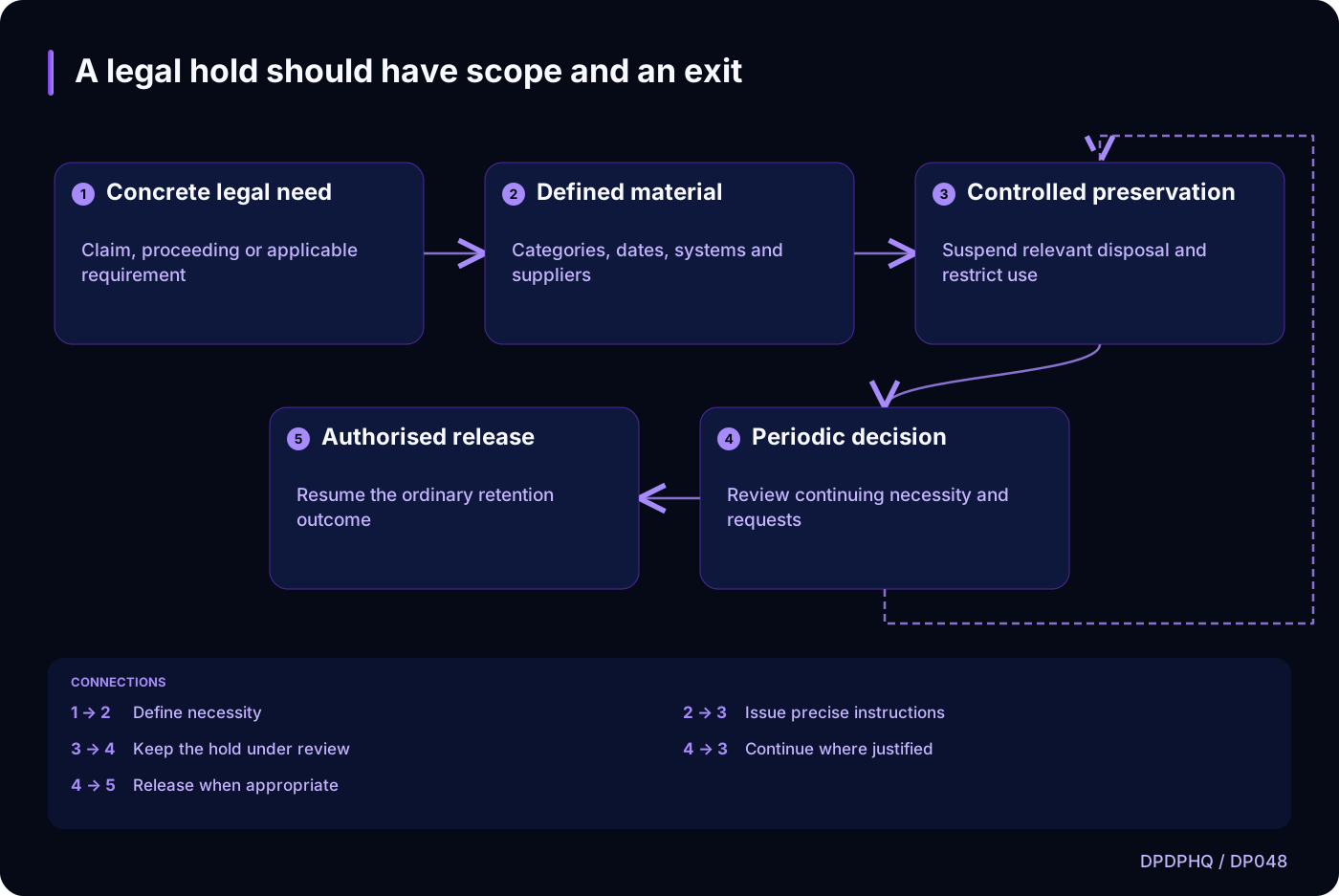
Text version of the diagram
- Concrete legal need: Claim, proceeding or applicable requirement
- Defined material: Categories, dates, systems and suppliers
- Controlled preservation: Suspend relevant disposal and restrict use
- Periodic decision: Review continuing necessity and requests
- Authorised release: Resume the ordinary retention outcome
- Concrete legal need → Defined material: Define necessity
- Defined material → Controlled preservation: Issue precise instructions
- Controlled preservation → Periodic decision: Keep the hold under review
- Periodic decision → Controlled preservation: Continue where justified
- Periodic decision → Authorised release: Release when appropriate
Sources and reading context
These references support the original 22 October 2026 research. Source links and the date above make the scope of this article explicit.
- Commencement notification for provisions of the DPDP Act · Paragraph (c)
Relevant substantive commencement
- Digital Personal Data Protection Act, 2023 · Sections 8(7), 12 and 17(1)(a)
Retention, erasure and legal-claim exemption limits
- Digital Personal Data Protection Rules, 2025 · Rules 6 and 8
Security and retention framework